15 minutes
These four cannot be sent to us at all, and any laboratory that offers to run them is selling you a number.
pH drifts as dissolved carbon dioxide leaves the bottle. Free chlorine is gone before the truck reaches the county line. Temperature is meaningless once the sample is in a cooler. These are analyse immediately parameters, which in practice means a calibrated field meter in the operator's hand at the sample tap. What we sell here is not analysis, it is the calibration and the annual verification that makes the operator's own reading defensible.
30 hours
The coliform window, and the reason this laboratory owns a van.
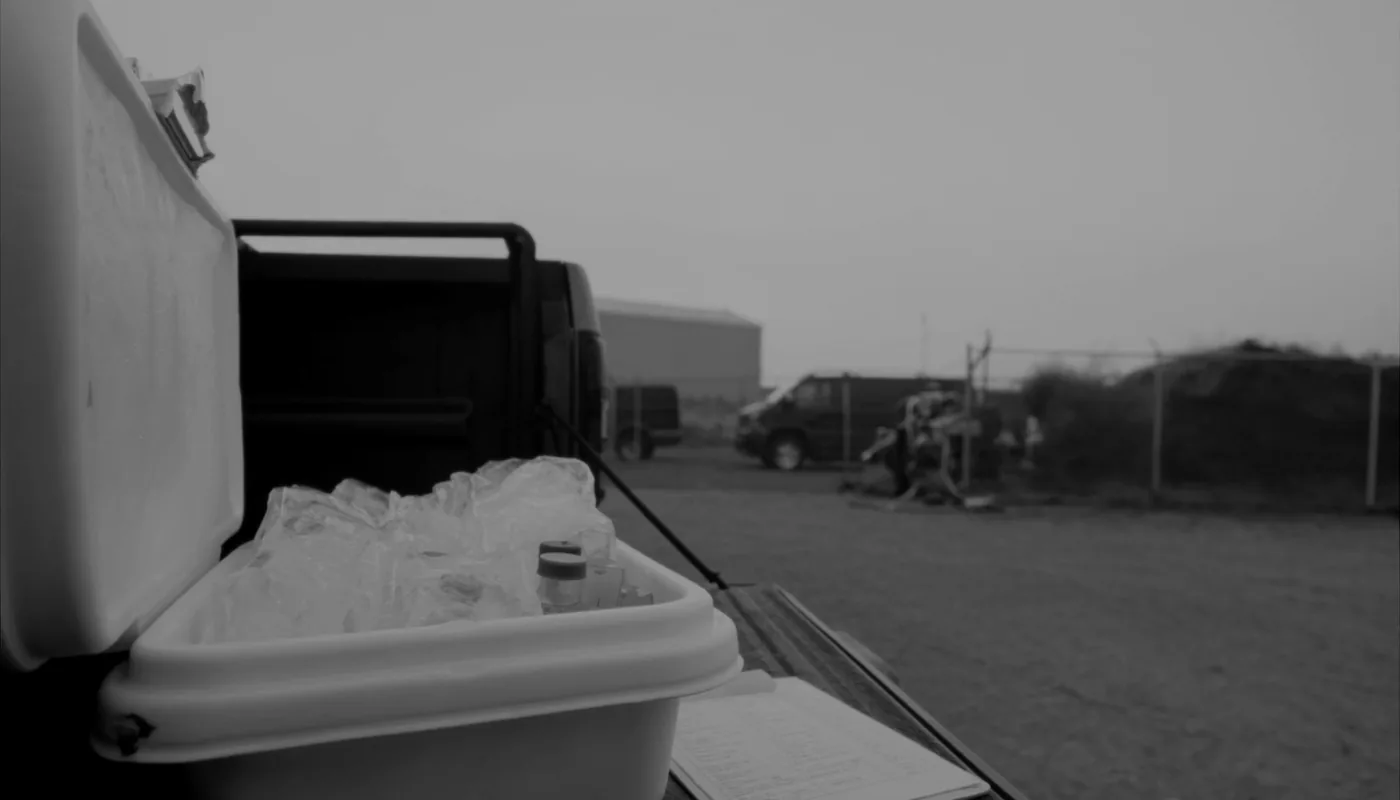
For routine drinking water compliance the sample must be under analysis, not merely delivered, within thirty hours of collection, and held below 10 °C on the way. Thirty hours sounds generous until you count backwards through a Friday. A system that draws at nine on Friday morning is at hour twenty-seven by noon on Saturday, which is why our Saturday bench runs at all and why the courier route below is built the way it is.
Bottles arrive from us pre-sterilised and containing sodium thiosulfate, which quenches the chlorine so the disinfectant does not keep killing organisms in transit. Do not rinse the bottle. Rinsing removes the thiosulfate and the result comes back absent when it should not.
48 hours
Two days, and turbidity has to be kept in the dark.
Turbidity is a physical measurement and it changes as particles settle or as algae grow, so the bottle travels in a closed cooler rather than on a truck seat. Nitrite converts to nitrate given warmth and time, which is why it carries a shorter window than its own parent. Nitrate itself gets forty-eight hours only if the water is unchlorinated; chlorinated systems get twenty-eight days, which is the single most commonly confused hold time in this business and the reason it appears in two bands on this page.
14 days
The by-products of your own disinfection, and the vials that must not hold a bubble.
Trihalomethanes and haloacetic acids form continuously in the distribution system, so the bottle carries an acid and a quenching agent to stop the reaction at the moment of collection. Volatile organics travel in three 40 mL vials filled to a convex meniscus with no headspace at all: a single bubble the size of a pinhead is grounds for rejection, because the analyte partitions into it. Invert the capped vial and tap it. If anything moves, draw it again.
28 days
Four weeks, which is long enough to stop thinking about the courier.
Anions are stable once cool, so this band is the comfortable one and it is where most of the annual monitoring schedule sits. Nitrate belongs here if the system is chlorinated, because the residual suppresses the bacteria that would otherwise reduce it. Two systems on the same road can therefore have different hold times for the same parameter, which is exactly the sort of thing that goes wrong quietly. If you are not certain which applies, say so on the chain of custody and we will treat it as forty-eight hours.
6 months
Acidified metals keep until summer, and the bottle is the whole method.
Nitric acid to below pH 2 holds the metals in solution instead of letting them plate onto the container wall, and once that is done the sample is stable for half a year. The failure in this band is almost never the hold time. It is the sampling: lead and copper compliance requires a first draw after six hours of stagnation, collected by the resident, from a tap they actually drink from, and a household that runs the shower first has produced a clean number that means nothing. We supply the bottle with the instruction sheet attached to it for that reason.